
Davidson County Arrest Records and Court Charges
Davidson County arrest records start on the law-enforcement side. The Davidson County Sheriff's Office runs the jail and publishes an official active inmate list for people in custody. The detention page says inmate information is public under North Carolina law, but it also warns that custody data changes quickly and can contain errors. The list is scheduled for weekday updates by noon. A booking or inmate listing can show that a person was arrested or held, yet it does not decide guilt and does not replace the court file.
The court charge record begins when criminal process or a charging document is filed in the North Carolina court system. In Davidson County, misdemeanors and infractions usually proceed in District Court, while felonies usually proceed in Superior Court. The District Attorney for Prosecutorial District 33 prosecutes criminal cases filed in the district. For custody and booking detail, use the Davidson County inmate records channel. For the full case file, plea, disposition, and sentence, use the Davidson County criminal court records channel.
Find Davidson County Arrest Records
Start with the record type needed. If the question is whether someone is currently in jail, use the Davidson Active Inmate List. If the question is what court charges were filed after an arrest, search the North Carolina eCourts Portal and narrow to Davidson County where possible. Portal Smart Search accepts a record number or a name in last, first format, and the training page explains wildcard searching for names and business names.
- Open Portal Smart Search and search by record number, defendant name, or a wildcard name search.
- Use Davidson County as the location filter when the advanced filters are available.
- Open the case summary and compare the listed charges with the case type, status, and hearing history.
- Check each charge for statute, offense description, class, disposition, sentence, probation, bond, or order status when shown.
Offline records still matter. Criminal, civil, special proceeding, and estates information can be searched at public self-service terminals in a Clerk of Superior Court office. Paper files are reviewed at the clerk's office in the county where the case is located. For sheriff reports or copy requests, the Davidson County Sheriff's Office directs users to a public records form and says email responses usually take three to five business days.
Davidson County Charges After Arrest
Charges after arrest can come from a citation, magistrate order, warrant, indictment, or other charging paper. North Carolina records may also show the offense statute, class, court, offense code, and whether the matter is a misdemeanor, felony, or infraction. One arrest can produce several separate charges, and a later court record can show a reduced charge, dismissal, plea, or sentence that differs from the first booking description.
| Document | Who Uses It | What It Means |
|---|---|---|
| Complaint or citation | Officer, magistrate, or prosecutor process | Often starts misdemeanors, infractions, traffic charges, or lower-level criminal matters. |
| Information | Prosecutor | A formal prosecutor-filed accusation used where North Carolina procedure allows that form. |
| Indictment | Grand jury and prosecutor | A felony charging document that commonly moves serious cases into Superior Court. |
The District Attorney for Prosecutorial District 33 represents the State in Davidson and Davie criminal cases, prepares criminal trial dockets, and advises law enforcement. The DA page states that misdemeanors and infractions are usually prosecuted in District Court and felonies are usually prosecuted in Superior Court.
Davidson County Charge Status
A charge is not frozen at booking. Court events can add a charge, amend the statute cited, reduce a felony to a misdemeanor, dismiss a count, or enter a final judgment after a plea or trial. Portal case summaries and judgment search results may show case number, status, location, file date, parties, disposition status, judgment comments, and hearing events. Paper files may have more detail than the public online summary.
| Status | What It Means |
|---|---|
| Pending | The charge has not reached a final disposition, or the public case summary has not been updated to show one. |
| Amended or reduced | The filed charge changed, often through prosecutor action, plea negotiation, or court order. |
| Dismissed | The charge was ended without a conviction on that count, though other counts in the case may remain. |
| Called and failed | The defendant missed a court call, which can lead to failure-to-appear consequences or an order for arrest. |
For traffic and infraction matters, the case number can help. North Carolina traffic guidance says a number with CR after the year includes at least one criminal offense, while IF indicates infractions only. That distinction helps separate a court traffic matter from a broader criminal charge record.
Davidson Charges vs Convictions
A Davidson County charge is an accusation in a court case. A conviction is a later result, usually from a guilty plea, responsible finding, or trial verdict. Public search results may show both charges and dispositions, so each count should be read separately. A dismissed charge may still appear in a historical court summary unless it is sealed or expunged.
| Charge | Conviction | |
|---|---|---|
| Stage | Filed after arrest, citation, warrant, or indictment. | Entered after a plea, finding, verdict, or judgment. |
| Record field | May show statute, offense, class, court, code, and status. | May show disposition, sentence, probation, costs, and restitution. |
| Use limit | Does not prove guilt by itself. | Shows a court result, unless later appealed, vacated, sealed, or expunged. |
Restricted Davidson Charge Records
North Carolina law opens many clerk-maintained records to public inspection, but some charge and arrest-related records are not treated as ordinary public files. Juvenile delinquency and abuse, neglect, or dependency matters have restricted access. Adoption files, mental-health proceedings, protected victim data, minor identifying information, Social Security numbers, and financial account data may be withheld or redacted. Expunction can remove eligible criminal records from ordinary public view.
| Sealed | Expunged | |
|---|---|---|
| Visibility | Hidden from general public access by law or court order. | Removed from ordinary public court and agency views after an order. |
| Limited access | Authorized parties may still see the file in some settings. | Confidential records may remain for narrow lawful court or agency purposes. |
| North Carolina path | Depends on the record type and order. | G.S. 15A-145.5 covers certain nonviolent misdemeanor and felony expunctions. |
The AOC-CR-281 expunction petition asks for file numbers, disposition or conviction dates, offense dates, arrest dates, offense descriptions, and dispositions. It also requires service on the prosecutor and authorizes criminal-history and pending-case checks before the judge rules.
Charge Codes and Severity Levels
Davidson County jail and court records may use short fields that need context. The active inmate offense list sample includes statute entries such as 15A-543BC and offense categories such as court violations, aggravated assault, DWI, kidnapping or abduction, drug violations, weapon law violations, parole or probation violations, and other agency warrants. It also shows court or agency codes such as DAVI, ALAM, PERS, and DCSO.
Class fields can mark an offense as F or M where shown. F means felony, and M means misdemeanor. Infractions are lower-level violations that are usually handled in District Court. Felony cases normally proceed in Superior Court after the required charging and screening steps. Because one arrest can have several charges, read each line separately instead of treating the booking as one single offense.
The U.S. Attorney's Office for the Middle District of North Carolina handles federal prosecutions, not Davidson County state charges. Federal case records use PACER and federal court systems rather than the North Carolina eCourts Portal.
Statewide Charge and Criminal History Lookups
The North Carolina Department of Adult Correction offender search is the state channel for sentenced prison offenders, probationers, and parolees. DAC says the database has historical information back to 1972. That search is different from a Davidson County arrest record because it focuses on correctional status and offender supervision, not the local arrest-to-charge path.
The North Carolina SBI sex offender registry is another state-level search, but it covers registered sex offender profiles. Court cases, active local custody, and public criminal case summaries still route through the Davidson County jail list, the Clerk of Superior Court, and eCourts Portal. For federal charges, use PACER or the CM/ECF court lookup.
The Middle District of North Carolina, Middle District Bankruptcy Court, and Fourth Circuit images in the official source set reflect how records move outside Davidson County when a matter is federal rather than state.
The U.S. District Court for the Middle District of North Carolina is the federal trial court for federal criminal prosecutions from this region.
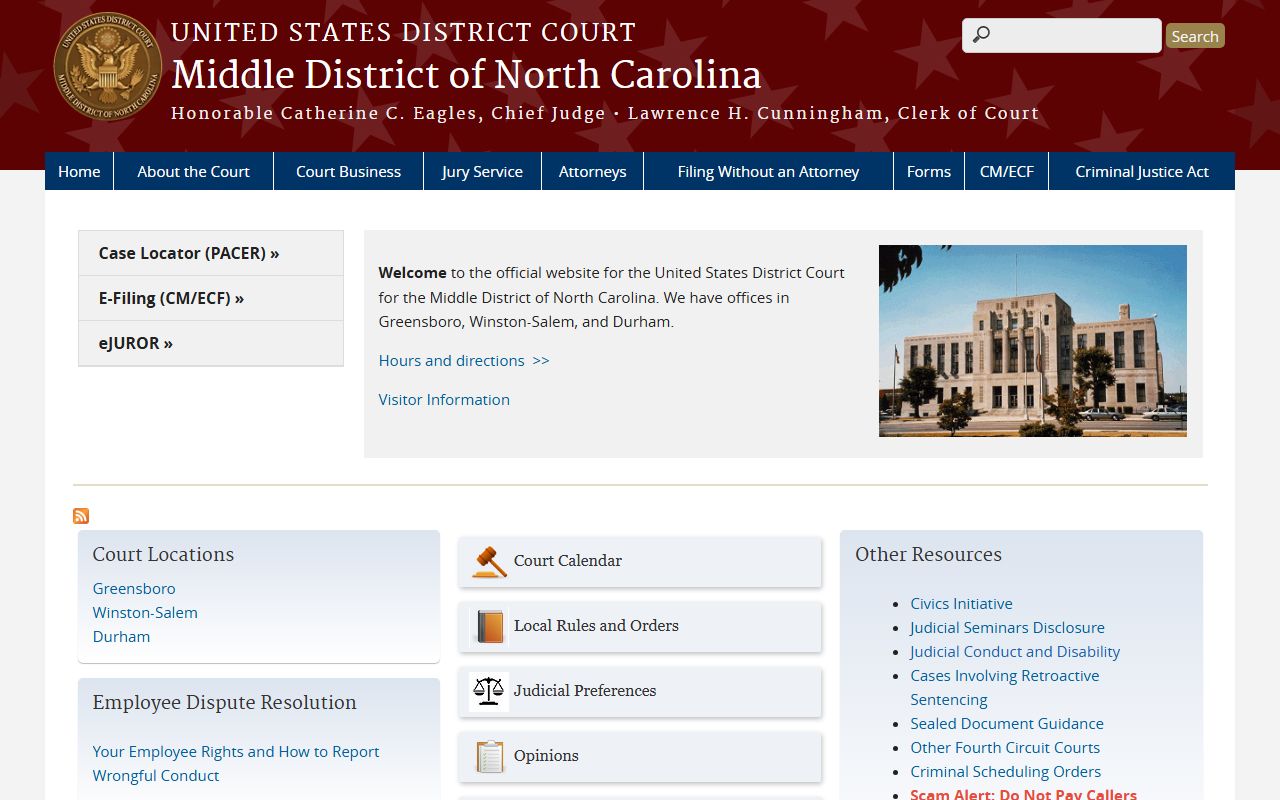
Federal criminal charges do not appear as Davidson County state court charges just because the defendant lives or was arrested locally.
The U.S. Bankruptcy Court for the Middle District of North Carolina is separate from criminal charge records, but it is part of the same federal records landscape for Davidson County residents.
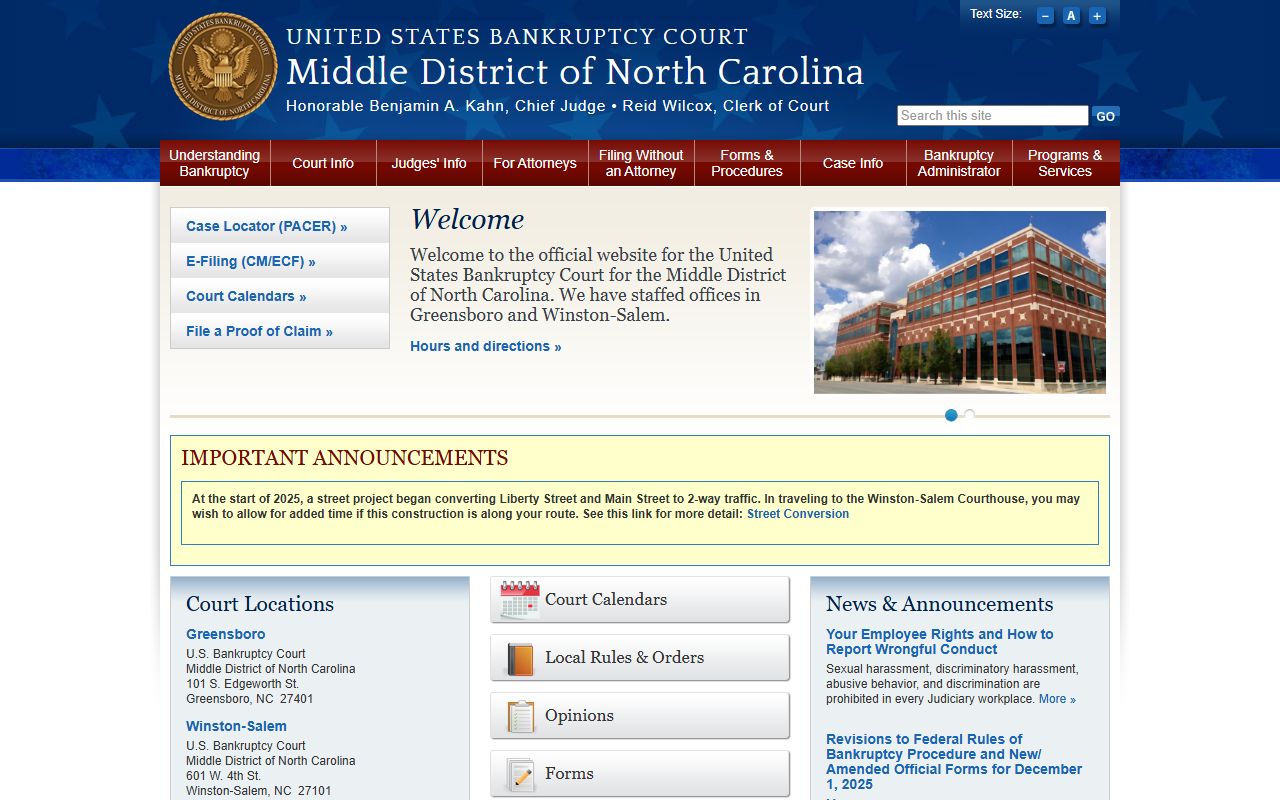
Bankruptcy case searches should not be used to confirm Davidson County arrest records or criminal court charges.
PACER's CM/ECF court lookup helps identify the correct federal court before searching a federal docket.
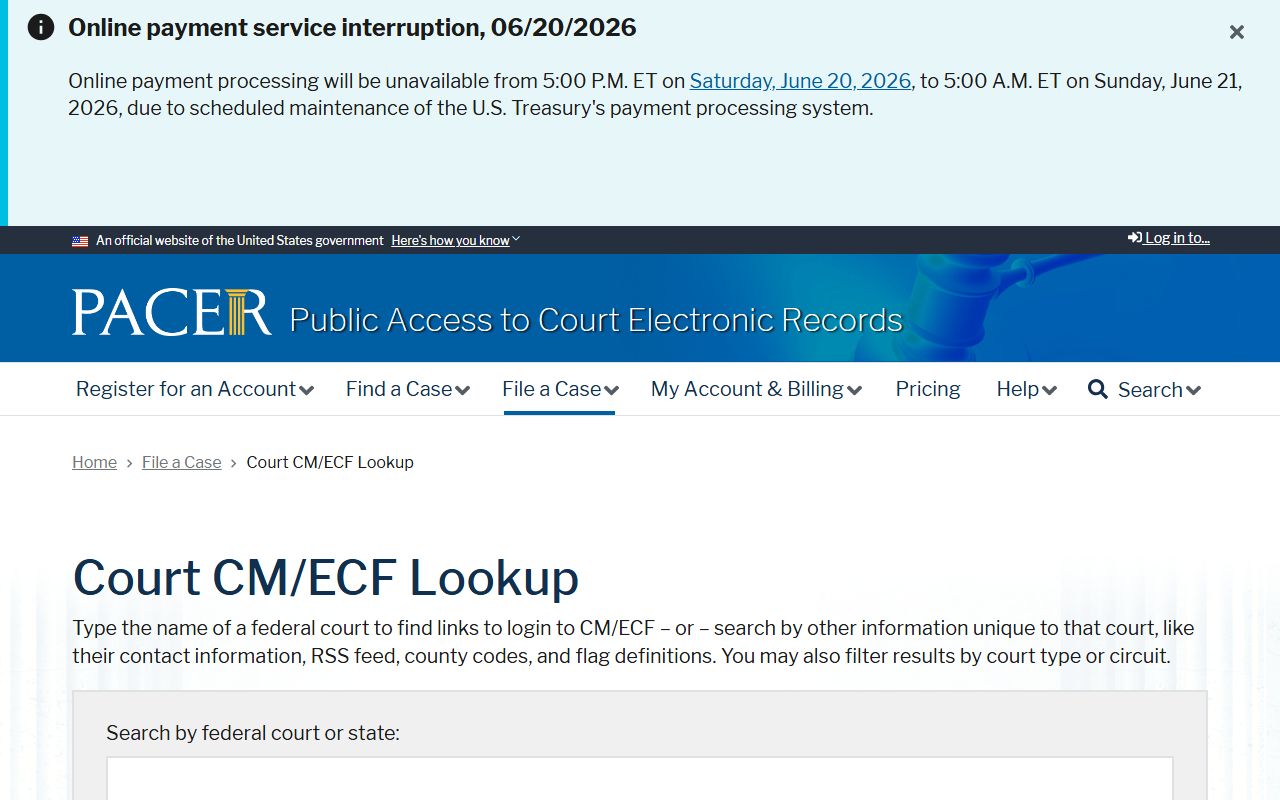
Use PACER only for federal cases; local court charges after arrest remain with North Carolina court and sheriff channels.
PACER registration and access is the official federal docket access route for federal case records.
PACER can confirm federal criminal dockets, but it will not replace Davidson County Clerk or sheriff records.
The U.S. Court of Appeals for the Fourth Circuit handles federal appeals from North Carolina federal courts.
Appeals records are useful only after a federal case has moved beyond the district court level.
The U.S. Attorney's Office for the Middle District of North Carolina prosecutes federal criminal matters in the region.
The federal prosecutor source helps separate state charges filed by the Davidson County DA from federal charges filed by the United States.
Background Check Considerations
Public arrest records and court charge searches are useful for locating official records, but they are not the same as a complete employment, tenant, credit, insurance, or licensing background check. A name search can miss records, return a person with the same name, or show an old charge without the later disposition. Portal also requires JavaScript and cookies, and anonymous, registered, and elevated-access users may face a CAPTCHA challenge every ten minutes.
Important: Verify arrest and charge results with the originating court, sheriff, or state agency before using them for any formal decision.
Public Access for Davidson Charges
G.S. 7A-109 requires clerks to maintain records, files, dockets, and indexes prescribed by the Administrative Office of the Courts. Unless another law bars disclosure, those records are open to public inspection during regular office hours. Chapter 132 also states North Carolina's public records policy, but court records are accessed through the court record rules and clerk channels.
For Davidson County, the practical access chain is Portal first, public terminal or clerk copy request second, and paper-file inspection when online summaries are incomplete. Police reports and sheriff records remain sheriff or county public-records matters. Marriage, birth, and death records route to the Register of Deeds, not the criminal court charge file.
Note: A public charge record can be accurate as a filing record even when the charge later ends without a conviction.