
Davidson County Criminal Court Records
A Davidson County criminal court record is the case-level file kept by the Clerk of Superior Court once a prosecution is filed in the North Carolina court system. It is broader than a charge list. It can include the charging document, case number, court level, hearing dates, bond orders, motions, pleas, trial activity, disposition, sentence, probation conditions, restitution, and court costs. For a closer look at the charge document itself, use the separate Davidson County arrest records and court charges page.
The court level matters. The District Attorney FAQ for Prosecutorial District 33 states that misdemeanors and infractions are usually prosecuted in District Court, while felonies are usually prosecuted in Superior Court. District Court trials are always before a judge. Superior Court trials are usually before a jury. Misdemeanor convictions from District Court may be appealed to Superior Court for a new trial where allowed.
The official District Attorney page for Prosecutorial District 33 is assigned to this criminal records page in the manifest.
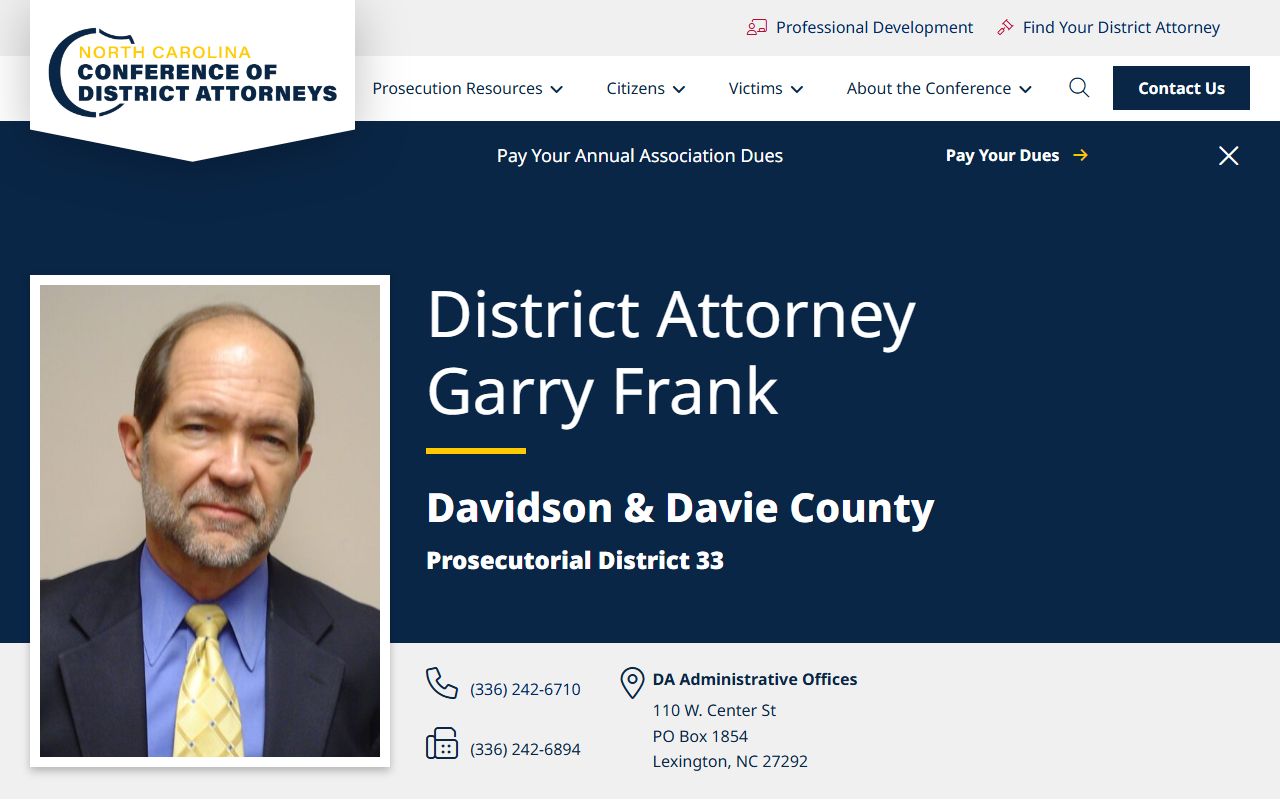
That source connects Davidson County criminal court records to the prosecutor's role in filing and managing criminal cases.
Search Davidson County Criminal Court Records
The main search tool is the North Carolina eCourts Portal. Smart Search accepts a record number or a name in Last, First Middle Suffix format. Advanced Filtering Options can narrow by Davidson County, case type, case status, filing dates, and party fields. Search Hearings can locate hearing dates by case number, party, attorney, judicial officer, or courtroom.
- Open eCourts Portal and choose Smart Search for a criminal case record.
- Search by defendant name or case number, using the required name format.
- Filter by Davidson County and narrow by criminal case type, status, or filing date if needed.
- Open the case result to review docket events, hearings, charge data, disposition, and financial entries.
- Request a certified copy or paper file review from the Davidson County Clerk of Superior Court when the online summary is not enough.
Public self-service terminals at clerk offices remain important. The Judicial Branch court-records help topic says criminal case information can be accessed at a public terminal in a clerk's office in any county. Criminal searches may use defendant name, case number, victim name, or witness name. Paper files are viewed at the clerk's office in the county where the case is located, and the Davidson County Courthouse page gives the local courthouse contact point.
Davidson County Criminal Case Flow
Criminal court records should be read as a sequence. A charge can begin with a citation, warrant, magistrate order, indictment, or other charging paper. After the case opens, the record may show first appearances, bond, counsel, arraignment, pretrial motions, plea offers, trial settings, continuances, verdicts, judgments, sentencing, probation, restitution, and appeal entries.
Case flow: Charges Filed › Arraignment › Pretrial and Motions › Plea or Trial › Disposition › Sentencing
| Stage | What the criminal court record may show |
|---|---|
| Charges filed | Offense description, statute, offense class, filing court, warrant, citation, magistrate order, indictment, or information. |
| Arraignment and counsel | Plea entry, attorney information, appointment status, and first case settings. |
| Pretrial and motions | Bond changes, continuances, discovery disputes, suppression motions, competency issues, and other orders. |
| Plea or trial | Guilty plea, not guilty plea, verdict, dismissal, acquittal, reduced charge, or amended charge. |
| Disposition and sentencing | Final result, sentence, probation, custody term, restitution, fines, costs, and appeal rights. |
What Davidson County Criminal Records Show
Davidson County criminal court records can include both case-level fields and charge-level fields. A case may contain several charges, and each charge can have its own statute, offense description, class, plea, disposition, and sentence. A single case may also include both crimes and infractions. The research notes that a North Carolina case number with CR indicates at least one criminal offense, while IF indicates an infraction-only case.
| Field | What It Shows |
|---|---|
| Case number | The court file number, including criminal or infraction clues when shown. |
| Defendant | Name and party details for the person charged in the criminal case. |
| Charge | Statute, offense description, offense class, filing source, and charge status. |
| Court level | District Court for most misdemeanors and infractions, or Superior Court for most felony matters. |
| Hearings and docket events | Court dates, motions, continuances, pleas, trial settings, orders, and failures to appear. |
| Disposition | Dismissed, guilty, not guilty, responsible, reduced, amended, appealed, or other result. |
| Sentence | Custody, probation, restitution, costs, fines, conditions, and compliance entries. |
| Restriction flags | Sealed, expunged, juvenile, protected victim information, redacted identifiers, or other access limits. |
Note: An online criminal case summary is not the same as a certified criminal court record or the full paper file.
Davidson County Charges vs Convictions
A charge is an accusation filed into the court process. A conviction is a final result based on a guilty plea, responsible finding, or verdict. Davidson County criminal court records can show charges that were dismissed, reduced, amended, dropped, or ended in an acquittal. Reading only the first charge line can give the wrong impression if the final disposition changed the case.
| Point | Charge | Conviction |
|---|---|---|
| Meaning | An alleged offense placed before the court. | A final guilty or responsible result after plea or verdict. |
| Record timing | Appears early in the case. | Appears after disposition or judgment. |
| Possible changes | May be amended, reduced, dismissed, or superseded. | May carry sentence, costs, probation, restitution, or appeal entries. |
| Use caution | Does not prove guilt. | Should still be checked for appeal, expunction, or later order. |
Davidson County Prosecution and Defense
The District Attorney for Prosecutorial District 33 is Garry Frank, and the district covers Davidson and Davie counties. The DA office prosecutes all criminal cases filed in the district and prepares the criminal trial docket. The DA page also says victims have rights to confer with the prosecutor and stay informed about court dates and developments. The DA cannot give legal advice to charged persons about charges, insurance points, or driver-license points.
Indigent Defense Services lists Davidson County as Defender District 22B. The IDS county page directs people asking whether they have a lawyer to contact the Clerk of Superior Court and provides an attorney lookup option when a lawyer's name is known. No separate Davidson County public defender office address was located in the official sources reviewed.
The image manifest assigns Indigent Defense Services Davidson County to this criminal records page.
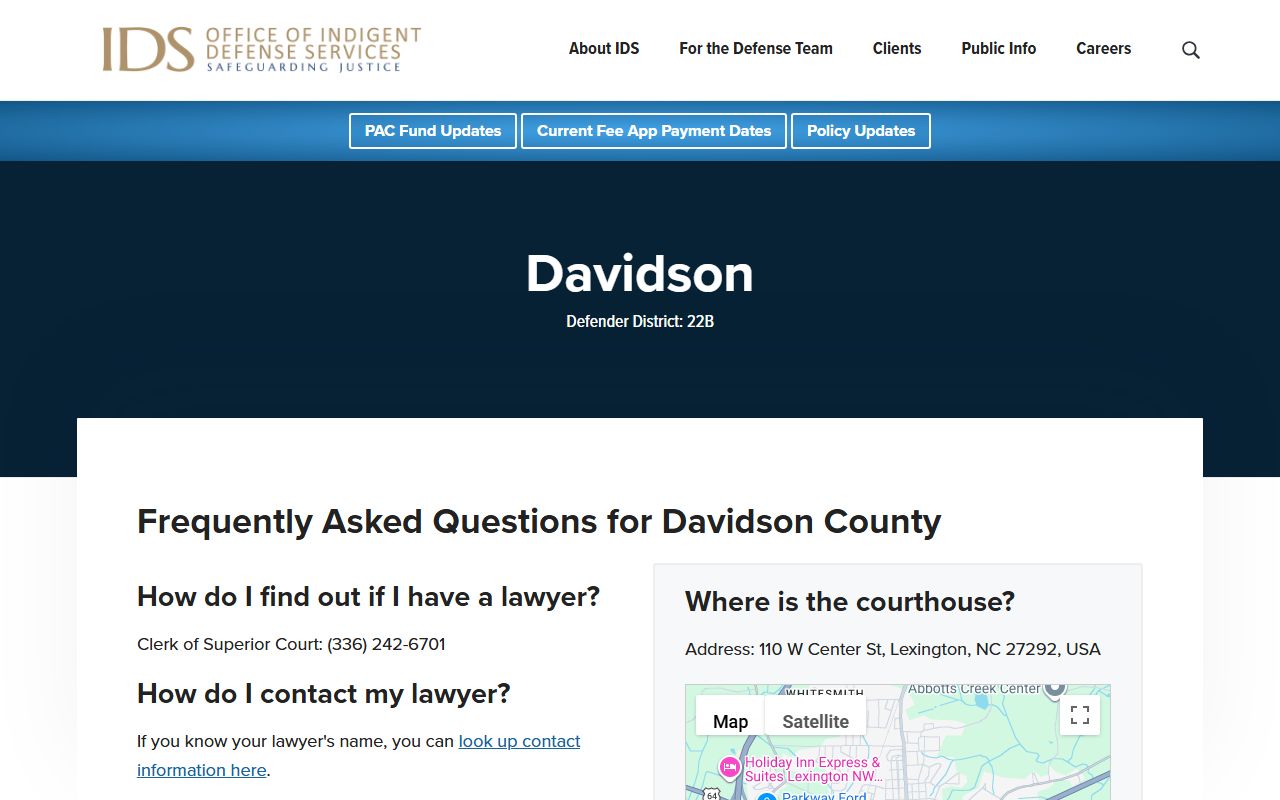
Defense appointment details can affect docket entries, continuances, pleas, and case timing in Davidson County criminal court records.
Sealed and Expunged Criminal Records
Criminal court access is public only where the law allows it. Juvenile delinquency records are not treated like adult criminal files. Sealed files are hidden from public view by law or court order. Expunged records are removed from ordinary public access under an expunction order. Adoption, mental health, minor identifying information, protected addresses, Social Security numbers, and financial account data may also be restricted or redacted.
| Point | Sealed record | Expunged record |
|---|---|---|
| Public visibility | Unavailable to the general public unless access is allowed by law or order. | Removed from ordinary public-facing court and agency access. |
| How it happens | By statute, rule, or court order. | By successful expunction petition and court order. |
| Example source | Juvenile, adoption, mental health, or protected case material. | Certain eligible nonviolent misdemeanor or felony records under G.S. 15A-145.5. |
| Residual access | Authorized parties or agencies may have limited access. | Limited confidential records may remain for lawful court or agency use. |
Expunction petitions such as AOC-CR-281 ask for file numbers, disposition or conviction dates, offense dates, arrest dates, offense descriptions, and dispositions. The form also requires prosecutor service and authorizes checks for criminal history, outstanding warrants, pending cases, and confidential AOC expunction records.
Public Access to Criminal Records
G.S. 7A-109 requires clerks to maintain court records, files, dockets, and indexes and makes those records open to public inspection unless disclosure is prohibited. G.S. Chapter 132 is North Carolina's general public-records law, but criminal court files are accessed through the court system and clerk process. The eCourts Portal, public terminals, paper file inspection, and copy requests are the practical routes.
The North Carolina Department of Adult Correction offender search is different from a Davidson County criminal court record search. It can help locate state prison offenders, probationers, and parolees, and the research notes DAC has historical information back to 1972. The North Carolina State Bureau of Investigation sex offender registry is also separate. Those tools are not substitutes for the court case file, plea, disposition, or sentence record.
The manifest assigns the DAC offender-search page to Davidson County criminal court records.
State offender data may help after sentencing or supervision starts, while Davidson County criminal court records show the court case path.
The manifest also assigns the NCSBI sex offender registry to this page.
The registry is a specialized public safety database, not a complete Davidson County criminal court case file.
Restricted Davidson County Criminal Records
Davidson County criminal court records can be missing from public results for lawful reasons. A juvenile file may be confidential. An expunction can remove a record from public view. A sealed order can block public inspection. Protected victim data, addresses, minor names, financial account numbers, and Social Security numbers may be redacted even when the rest of a file is public.
People who need a restricted criminal court record generally need party status, attorney access, a court order, or another legal right. Clerk staff can explain where a record is kept and whether a public copy can be requested, but they do not provide legal advice on eligibility, strategy, or expunction outcomes. For active warrants or custody status, use the proper sheriff, jail, magistrate, or court channel rather than treating the criminal case summary as real-time arrest information.